September Policy Survey: Summary of Findings
Rainey Center. 1,004 registered voters, online panel, September 10-14, 2026. Weighted on age, gender, race, education, 2024 vote recall, and region. MOE ±4.9.
Cost of living crowds out everything else. Groceries, gas, and utilities lead issue salience at 57%, more than double jobs and the economy at 30%. Healthcare costs are 29%, Social Security and Medicare 26%, housing 20%. Eighty percent call inflation critical to their daily life. AI registers at 12% and data centers at 7% as top-three issues. Trump approval is 41/59.
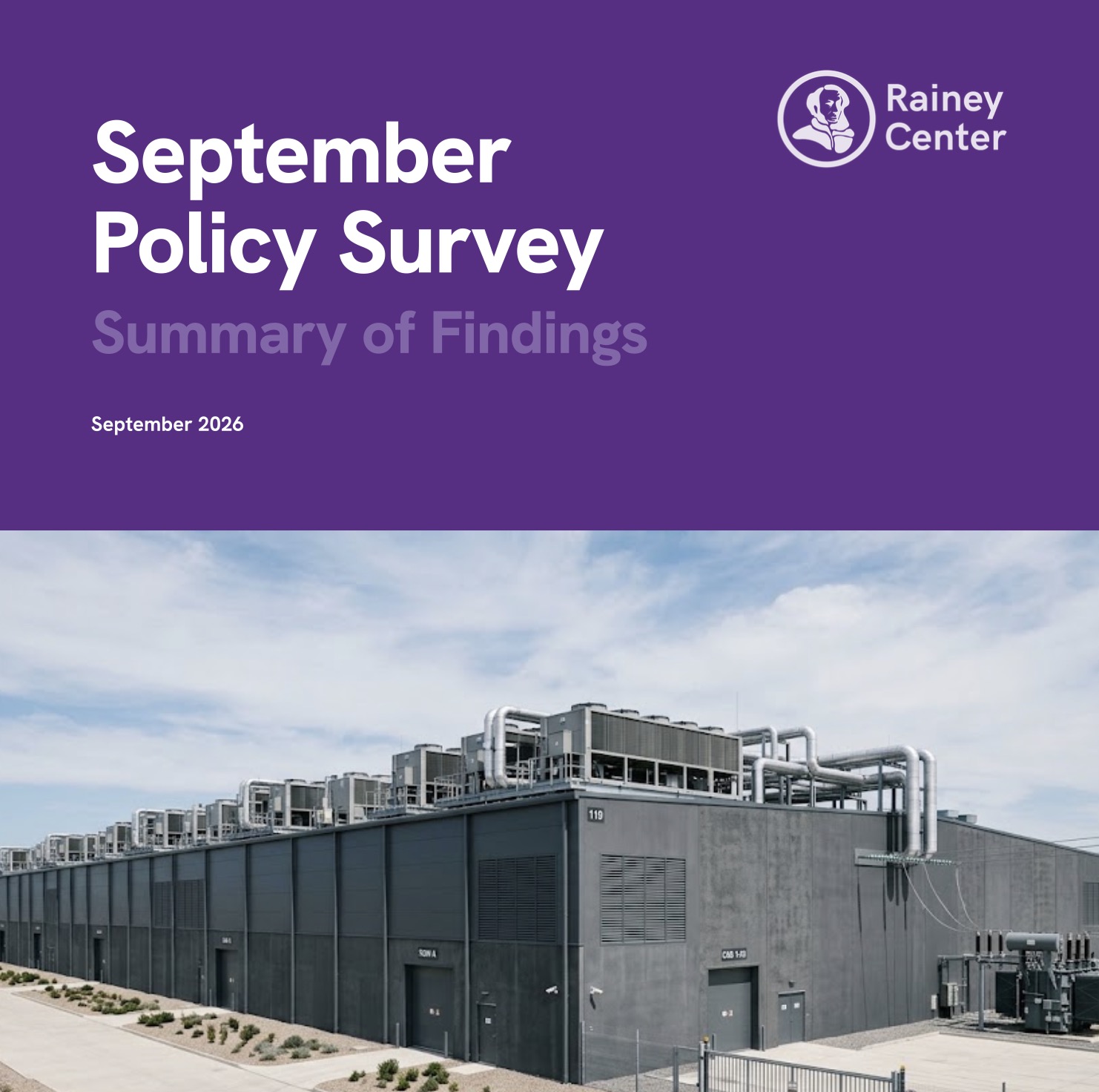
Data centers are a low-salience, high-valence negative. Favorability is 29/57. Opposition to a project in the respondent's own community is 27/62, with 42% strongly opposed. Awareness is near universal at 92%, and 29% believe one is operating or proposed nearby. Opposition is cross-partisan and rises with age and rurality: 62% of very liberal voters and 54% of rural voters are strongly opposed, against 27% of Republican 2026 voters.
The objection is price and process, not aesthetics. Among unfavorable voters, electricity costs for residents lead at 28%, water use 18%, distrust of the companies 14%, AI job loss 11%. Noise and appearance draw 2%. Seventy-one percent support requiring community benefits agreements before construction, and 38% name making data center companies pay their own electricity a top AI priority for lawmakers.
Opposition has become a voting cue. Forty percent say a candidate's opposition to data centers makes them more likely to vote for that candidate, against 15% less likely. In the forced county-office choice, the opponent wins 44-20.
Conditional recruitment beats both moratorium and boosterism. In the paired lawmaker-approach exercise, the leading package at 64% preference recruits investment while requiring developers to bring their own power, hold public meetings, sign community benefit agreements, and accept curtailment before homes. Defending existing tax breaks finishes last at 35%. The single-choice follow-up fragments badly, with no option above 14%, so read the pairwise tiers rather than Q64.
Water beliefs are media-transmitted and overstated. Forty-eight percent believe a data center uses far more water than almost any other facility. Among them, the sources are local TV and newspapers (45%), national newspapers (32%), and cable (27%). Social platforms are minor.
AI use is broad, affect is negative. Fifty-two percent use AI tools at least monthly and 42% use chatbots, but 41% say nothing about AI excites them and 70% are annoyed to learn content was AI-generated.
Two clean consensus findings. Watermarking requirements draw 78% support with no partisan gap (82% D, 77% R, 75% I). Sixty-one percent want AI regulated mostly at the federal level for uniformity, against 20% preferring state-level variation.